
First-Year Writing Program
Director of First-Year Writing: Dr. Sarah Lonelodge
- · Office: HL Griffin Hall, Room 214
- · Phone: 337-482-5501
- · Email: sarah.lonelodge@louisiana.edu
Assistant Directors of First-Year Writing
- · Evangeline Han
- · Lovely Kalam
- · Meisam Khalilinejad
- · Karleigh Peoples
-
· Safi Ullah
Mission Statement
The First-Year Writing (FYW) program at the University of Louisiana aims to prepare students to be rhetorically-minded members of society. Because critical and creative thinking is imperative both inside and outside the university setting, students in our program will practice composing in a variety of genres and for various audiences in academic and non-academic contexts. They will hone research skills and employ strategies for analysis, evaluation, research, response, and more. Our goal as a program is to guide and support students so that they may gain confidence in their own voices and grow as thinkers, researchers, and writers.
Within all FYW courses, students engage in learning through discussion, process work, peer feedback, reading, presentation, activities, analysis of mentor texts, drafting stages, and more.
English Composition Program
The General Education Curriculum is a set of courses required in all colleges and majors. It is designed to ensure that graduates acquire the knowledge and skill to live productive lives as responsible and knowledgeable citizens of their region, their country and the world, capable of working effectively with others while displaying openness to different viewpoints and understanding the diversity of human values. Through general education courses, graduates learn to appreciate the possibilities of human achievement and the patterns of human thought in both the arts and the sciences. To this end, courses in the General Education Curriculum ensure broad learning across the humanities, arts, social studies, and life and physical sciences, while teaching competence in technology, communication, critical thinking and analytical skills.
English Composition (6 credit hours)
ENGL 101 - Introduction to Academic Writing Credit Hours: 3
or
ENGL 103 - Foundations of Academic Writing Credit Hours: 3 and ENGL 104 - Foundations of Academic Writing Tutorial Credit Hours: 3
and
ENGL 102 - Writing and Research About Culture Credit Hours: 3’
or
ENGL 115 - Honors Academic Writing Credit Hours: 3
International students / ESL
International students whose first language is not English and who have not graduated from a U.S. high school are required to take First-Year Writing in the Department of Modern Languages (ESOL 101 and 102). Students who are non-native speakers of English but who are U.S. residents and who have graduated from a U.S. high school have the option to take English or ESOL writing courses. However, students must finish the sequence they began; for example, a student cannot go from English 101 to ESOL 102 or ESOL 101 to English 102.
What is the Purpose of First-Year Writing?
In the first-year writing (FYW) program, we teach writing so that students can thrive as members of society. The ability to think and write helps to ensure that people are not taken in by misinformation, that they are not easily manipulated, and that they can make good decisions about the future.
As the name suggests, FYW courses prioritize writing. However, the word writing encompasses more than putting words on a page. Writers must read, analyze, interpret, synthesize, research, organize, design, and much more in order to do what the word writing really means—creating meaning and sharing ideas with others as part of a larger conversation. Writing, therefore, happens constantly. In the workplace, people write emails, give presentations, develop proposals, research new products, conduct performance reviews, and so on. And in everyday life, we might go before city council to suggest an improvement to our community, interact with our child’s teacher, or decide to run for public office. Writers, therefore, are also often speakers, presenters, and designers. The FYW program at UL emphasizes these aspects of writing as foundational elements of our learning goals and outcomes.
Learning Goals and Outcomes
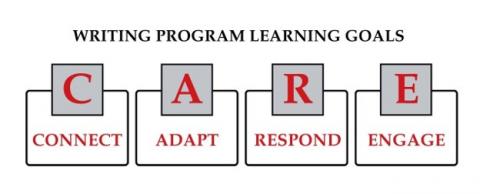
CARE: Connect, Adapt, Respond, Engage
Connect: Students will be able to…
- · Reframe their mindset about writing and expand conceptions of what writing means.
- · Evaluate technology to determine if, when, and how to employ writing tools.
- · Build a classroom community of writers based in ideating, feedback, and discussion.
- · Reflect on writing strategies and processes and explore possibilities across drafts.
- · Recognize the potential in their own voice, ideas, and questions.
Adapt: Students will be able to…
- · Employ rhetorical theory to decide how best to approach new ideas and contexts.
- · Demonstrate purposeful flexibility and adapt to a variety of rhetorical situations.
- · Design their writing within and for appropriate genres and discourse communities.
- · Navigate stylistic and modal choices for specific rhetorical situations.
- · Employ rhetorical listening and slow response to explore new perspectives and ideas.
Respond: Students will be able to…
- · Engage in the discovery process of research and explore new cultural contexts.
- · Interact with and evaluate new and different sources of information.
- · Synthesize across sources of information to reach beyond prior knowledge.
- · Generate new perspectives and ideas and integrate their ideas with others.
- · Determine why documentation matters and employ resources for how to cite ethically.
Engage: Students will be able to…
- · Engage with academic and public discourse within local, regional, and global society.
- · Evaluate multiple perspectives to find nuanced ways to address problems.
- · Write to affect real change by sharing research, ideas, and writing with others.
- · Justify research methods, positionality, approaches, and solutions.
- · Respond within specific, appropriate genres for particular rhetorical situations.
CARE: Students will be able to…
- · Value the possibilities and purposes of research and writing.
- · Determine effective and ethical uses of writing technologies and GenAI outputs.
- · Reflect on the potentialities of writing in all of its communicative modes.
- · Engage in ongoing conversations taking place in academic and public discourse.
- · Identify the role of writing within their everyday, academic, and professional lives.
Ann Dobie Outstanding Essay Awards
In recognition of outstanding effort and achievement in composition classes, all first-year writing instructors are encouraged to nominate student writing projects that reflect the learning outcomes and objectives established by the First-Year Writing Program. The authors and instructors are recognized at the English Department’s award ceremony at the end of the spring semester.
Bernice & Robert Webb Graduate Teaching Award
The Bernice and Robert Webb Award for Excellence in Teaching at the Entry Level is given in recognition of a graduate student teacher with no more than 3 semesters of college teaching showing growth in the classroom.